
Export Tariffs (SEG)
How Smart Export Guarantee tariffs work, how households are paid for unused solar electricity and what affects the value of exporting power back to the grid.
Paid For ExportsMetered output
SUPPLIER-SET RATES
Varies By Tariff
Smart Export Guarantee (SEG)
-
The Smart Export Guarantee is a government-backed scheme in Great Britain that pays eligible small-scale renewable generators for electricity exported back to the grid. For most households with solar panels, it is the route used to receive payment for unused electricity rather than letting it leave the home unpaid.
The scheme replaced the old Feed-in Tariff route for new applicants. Unlike the Feed-in Tariff, SEG payments are not fixed by government. Suppliers set their own export tariffs, contract terms and payment structure, provided the tariff always remains above zero.
Under SEG:
electricity suppliers set their own export tariffs
payments are based on actual electricity exported
a smart meter or export meter is normally required
Typical domestic solar systems are well within the size limits for the scheme. Eligible technologies include solar PV, wind, hydro, anaerobic digestion and micro-CHP, with installations required to be in Great Britain.
-
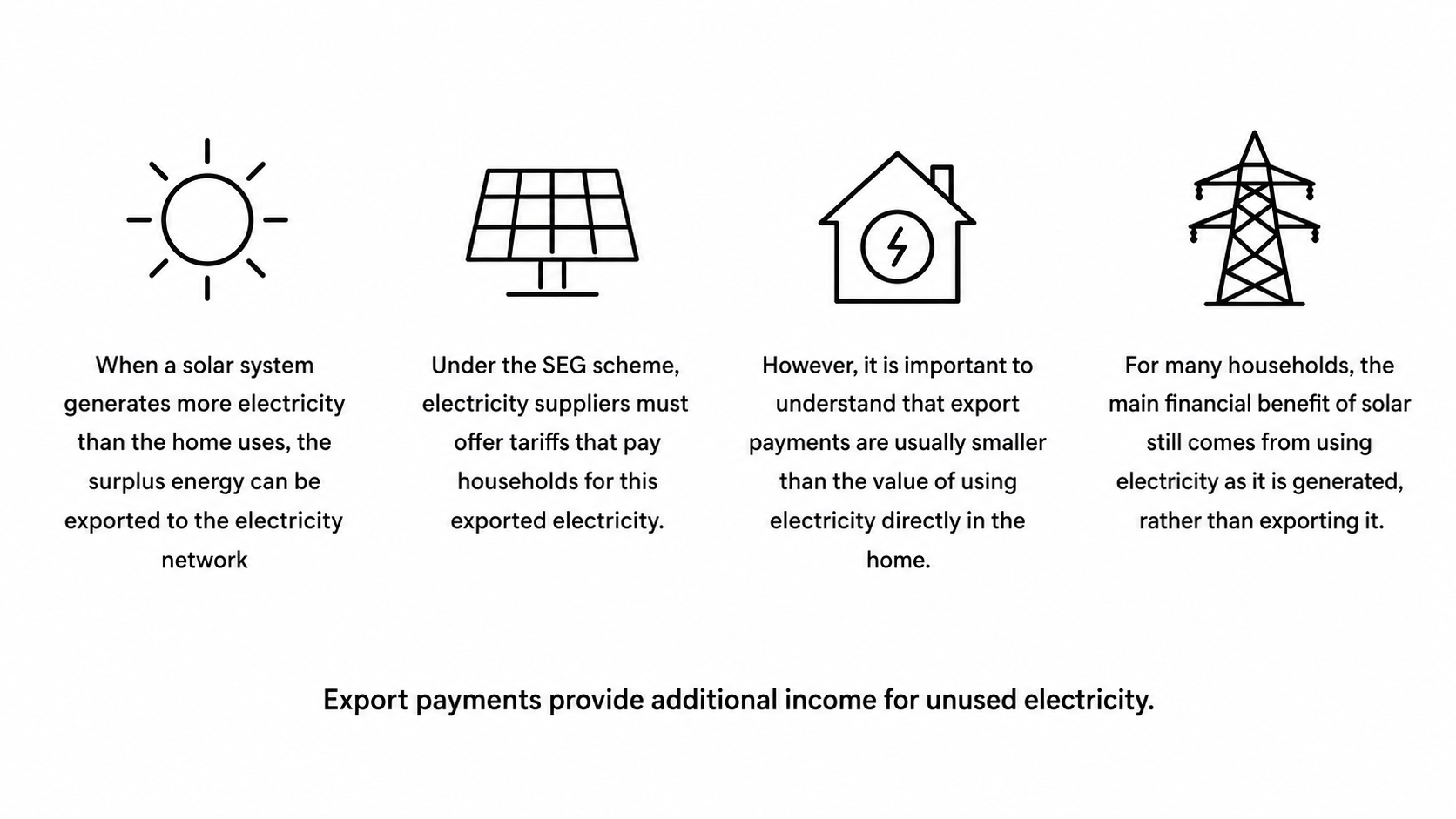
SEG payments are based on the amount of electricity your system actually exports to the grid. Electricity used in the home is not exported and does not receive SEG payments.
In simple terms, if your solar system generates electricity during the day and your household uses part of it straight away, only the remaining unused electricity is exported and paid under your chosen export tariff. This is why export income and bill savings are related but not the same thing.
Payments are normally based on readings from a smart meter or another approved export meter. Some suppliers may offer different payment models, but eligible generators are still entitled to be paid on actual meter readings.
Export amounts are usually measured using:
• a smart meter capable of measuring export
• or an approved export meter installed with the system
Payments are normally made:
• quarterly
• or as bill credit with the electricity supplier
-
There is no single SEG rate. Each supplier sets its own export tariff, contract length and terms, which means rates can vary materially from one provider to another. Some tariffs are fixed and some are variable.
For that reason, this page should avoid locking in one “normal” pence-per-kWh figure unless you plan to update it frequently. A better NUVOE-style explanation is that export value depends on the supplier, the tariff structure and how much electricity is actually exported.
For many households, the main financial benefit of solar still comes from using electricity in the home while it is being generated. Export payments can add value, but they are usually one part of the overall picture rather than the only source of benefit.
-
How much SEG pays
SEG rates vary between suppliers because each supplier sets its own tariff.
Typical rates currently offered in the UK often fall between:
3p and 15p per kWh exported
However, some specialist tariffs linked to smart tariffs or time-of-use plans can offer higher export rates in certain circumstances.
Examples of SEG tariffs offered by UK suppliers include:
Octopus Energy – Smart Export Guarantee
E.ON Next – Export tariff information
British Gas – Export tariff information
Tariffs and eligibility requirements change regularly, so households should check current rates with suppliers.
-
System size
Larger systems can generate more electricity and may export more unused power, especially in brighter months.Household daytime electricity use
Homes that use more of their solar electricity during the day will usually export less. That may reduce SEG income but can improve bill savings because less power is bought from the grid.Supplier tariff choice
Different suppliers offer different export rates and different terms, so the value of the same exported electricity can vary by tariff.Battery storage
A battery can store excess solar electricity for later use. That may reduce exports but increase the value you keep in the home. Some suppliers may also place conditions on what they will pay for where storage is involved. -
To receive SEG payments, households need to apply directly with a supplier offering an export tariff. Signing up is not automatic.
You do not have to use the same company for your export tariff as for your normal electricity supply. In practice, that means you can compare export deals separately rather than assuming your existing supplier is the best option.
Requirements usually include proof that the installation is certified under the Microgeneration Certification Scheme (MCS) or equivalent, together with a registered smart meter that records exported electricity. For solar, the system must also fall within the scheme’s size limits, which typical domestic systems do.
A simple way to explain the process is:
Install eligible solar → make sure certification and metering are in place → choose an SEG supplier → apply for the export tariff → submit readings or allow smart export measurement → receive payment under the tariff terms.
Official Links
Households wanting to explore the scheme further can read the official guidance from Ofgem.