
Solar panels can lower electricity bills, but the biggest question is usually:

Solar panels can reduce your electricity bills by generating power at home and you may receive payments for any electricity you export back to the grid.
The main factor to consider is the upfront cost of installation.
In the UK, there is no single nationwide solar grant that households can apply for directly.
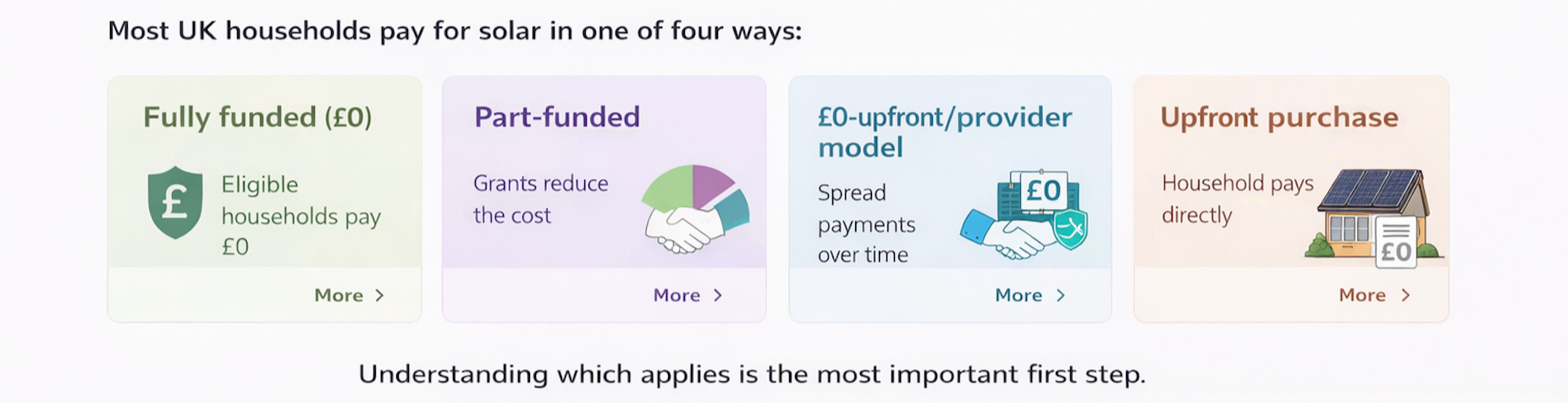
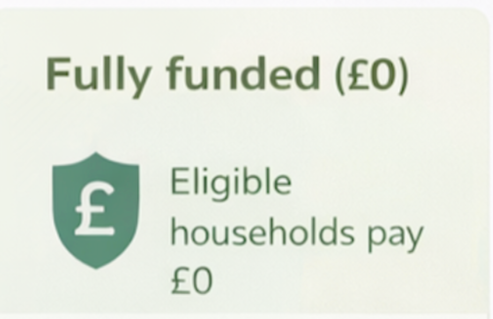
However, some households do receive solar panels fully funded when solar is installed as part of a wider home energy upgrade programme.
This usually happens where improving the overall efficiency of the home is the primary goal, and solar is added alongside measures such as insulation or heating improvements.
Fully funded installations are most commonly delivered through:
Local authority home upgrade programmes
Many councils deliver government-funded retrofit schemes aimed at improving inefficient homes. Where appropriate, solar panels may be included as part of the upgrade package.
These programmes are now commonly delivered through the Warm Homes: Local Grant
Government overview:
https://www.gov.uk/improve-energy-efficiency
Energy Company Obligation (ECO4)
ECO4 is a supplier-funded scheme focused primarily on insulation and heating improvements. In some cases, solar panels may be included where they form part of a wider energy efficiency improvement.
Ofgem guidance:
https://www.ofgem.gov.uk/environmental-and-social-schemes/energy-company-obligation-eco
Social housing retrofit programmes
Some housing associations and local authorities install solar panels as part of long-term decarbonisation programmes for social housing tenants.
When fully funded solar typically applies
Fully funded installations are normally limited to households where:
the property has a low EPC rating or is expensive to heat
the household meets income or vulnerability criteria
the property is suitable for installation
funding is available locally at the time of assessment
Because these programmes are locally delivered, availability varies by area.
Explore more on grants - link
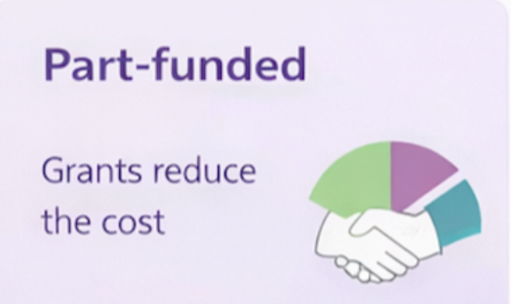
Some households receive financial support towards solar installation as part of wider home energy improvement programmes.
These arrangements typically combine:
government or council funding
a household contribution
installation delivered through an approved programme
Part-funded support is more common than fully funded solar installations.
Current UK support routes that may include solar
Solar may be included through:
Warm Homes: Local Grant
Local authority-led programmes providing funded home upgrades for eligible households. Solar may be installed alongside insulation or heating improvements where suitable.
Government overview and application:
https://www.gov.uk/apply-warm-homes-local-grant
Energy Company Obligation (ECO4)
A supplier-funded scheme focused primarily on insulation and heating improvements. Solar can be included in limited cases where it forms part of a wider efficiency upgrade. The current phase runs until March 2026.
Scheme overview:
https://www.ofgem.gov.uk/environmental-and-social-schemes/energy-company-obligation-eco
VAT relief on solar installations
Solar panels and battery installations are currently zero-rated for VAT, reducing installation costs for households installing systems directly.
Government guidance:
https://www.gov.uk/guidance/vat-on-energy-saving-materials
For more information on support, eligibility… visit —- link
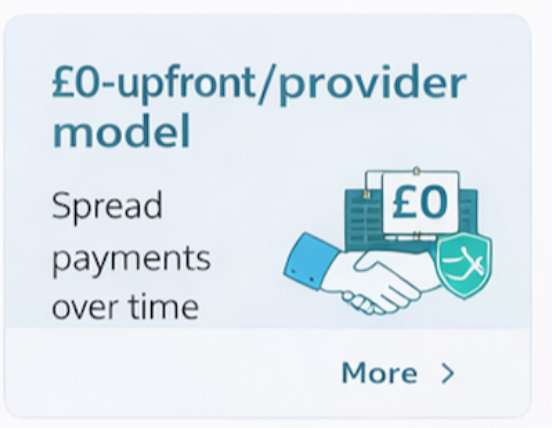
PROVIDER SUPPORT / £0-UPFRONT MODELS (Installed now, cost recovered over time)
Some companies offer solar installation without an upfront payment.
In these arrangements, the cost of the system is recovered over time rather than paid at installation.
This can work in different ways depending on the provider, including:
monthly payments or subscriptions
agreements linked to energy savings or usage
shared benefit arrangements
long-term service or leasing contracts
Because the installation cost is not paid upfront, ownership and financial benefits can be structured differently from a standard purchase.
In some arrangements:
the provider owns the system for a period of time
savings may be shared or offset by payments
contracts may remain attached to the property during the agreement term
These models can reduce upfront cost but should always be understood in full before proceeding.
Official guidance
Energy Saving Trust — solar panels advice
https://energysavingtrust.org.uk/advice/solar-panels/
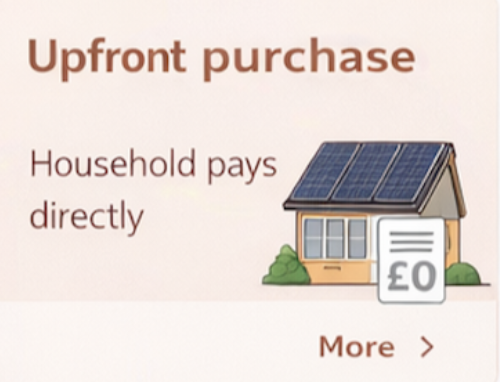
STANDARD UPFRONT PURCHASE (You pay, you own)
This is the traditional way solar panels are installed.
The household pays the full installation cost directly rather than using funding or provider-supported arrangements.
Payment is usually made through:
savings
installer finance
a personal loan
Once installed, the system belongs to the homeowner.
This means:
you own the solar panels and equipment
you keep all electricity bill savings generated
you receive export payments through the Smart Export Guarantee (SEG)
there are no ongoing provider contracts attached to the system
Because the system is owned outright, this route gives households full control over how the system is used and how long it remains in place.
Typical cost range
Solar system prices vary depending on system size, installation complexity and installer pricing.
According to the Energy Saving Trust, a typical domestic 3.5 kilowatt-peak solar PV system costs around £6,100, though prices can vary depending on:
system size
installer
property location
Official source:
https://energysavingtrust.org.uk/advice/solar-panels/